What The Blac Teaches Us About Designing Spaces People Want to Stay In
Most restaurant owners think design is about aesthetics. And they’re not wrong. But they’re only half right. The real question isn’t whether a space looks good. It’s whether it makes people want to stay, come back, and bring someone with them next time.
When we designed Cafe BLAC at Nawala, we weren’t just delivering another hospitality project. This was our own milestone, the café that marked ten years of ARA’s design journey. That gave us the freedom to design without compromise, and to put into practice everything we’d learned about what makes a commercial space truly work.
What came out of that process taught us more than we expected. Here are four lessons from The Blac that apply to any business owner thinking seriously about their space.
The Brief: Designing a Space That Earns Its Own Vibe
“Not just a place, it’s a whole vibe.” That’s how The Blac’s own audience describes it on social media, unprompted. Such language does not happen by accident. It’s the result of design decisions that were made before a single chair was sourced.
The brief was deliberate from the start: a nature-inspired coffee shop and restaurant in the heart of Nawala that would feel like an escape from the city without pretending to be anywhere other than where it is. “Where Nature Meets Flavour” wasn’t just a tagline. It was a design directive.
The challenge was making nature feel visceral in an urban setting. The answer was not a soft, pastel café with potted succulents. It was something far more considered and bolder.
“Where Nature Meets Flavour” wasn’t just a tagline. It was a design directive.
Lesson 1: Dark and Natural Are Not Opposites
The most persistent misconception in nature-inspired hospitality design is that it has to be light, airy, and green-dominant. Muted tones, rattan, exposed wood. The Blac disproves this entirely.
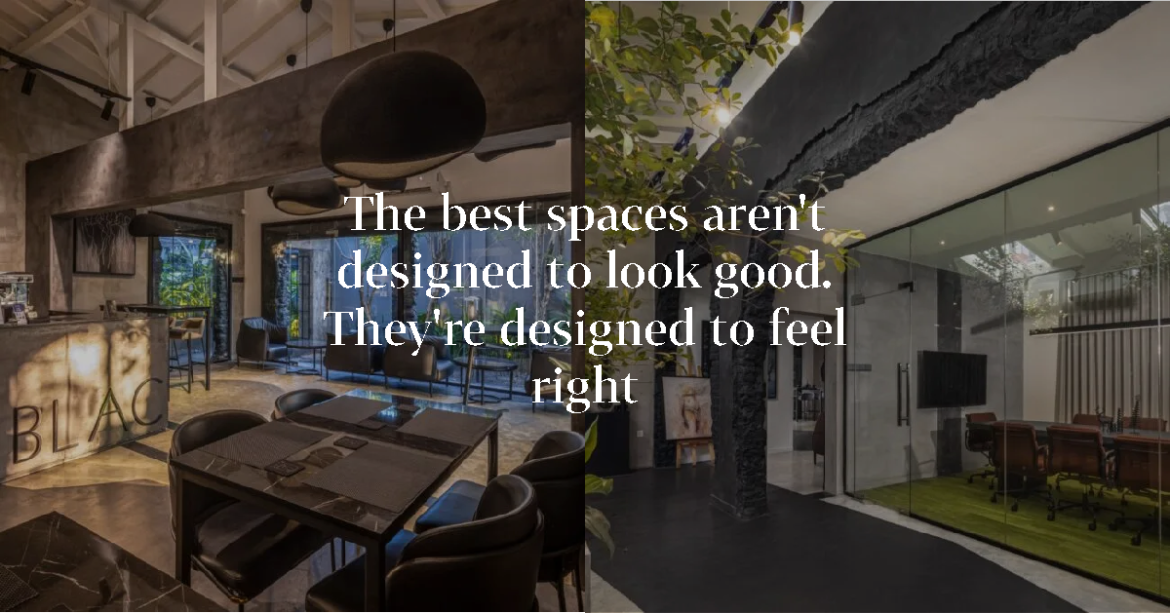
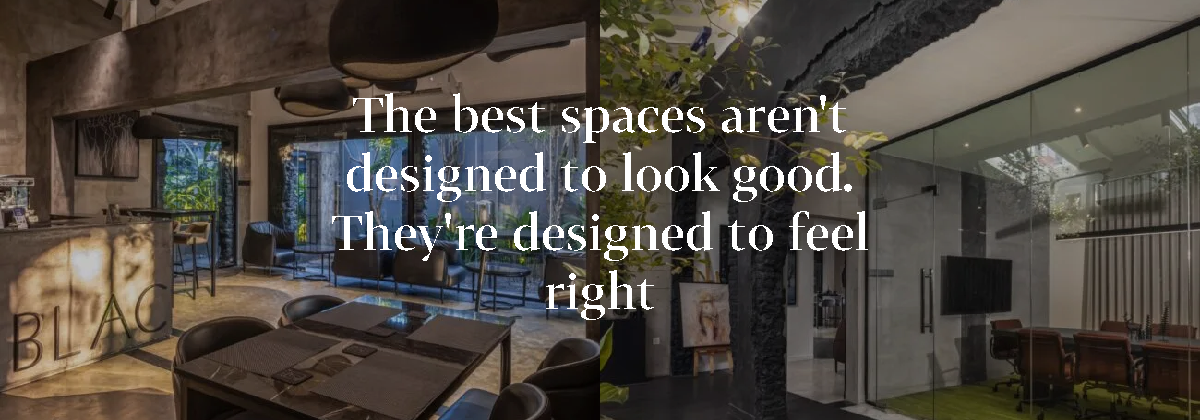
The palette is predominantly black. Dark walls, dark furniture, matte black finishes throughout the space. And then, woven through all of it: living trees. Real greenery with real presence not decorative filler, but plants that occupy volume and command attention.
The contrast between the dramatic, moody interior and the organic life of the trees creates a tension that’s genuinely arresting. It’s why guests photograph the space the way they do. And it’s why those photographs hold your attention longer than the typical bright-and-airy café shot.
This matters for restaurant and café owners for a straightforward reason: the default instinct when incorporating nature into a hospitality space is to go warm and light. But the most memorable iteration of that idea is often the unexpected one. Dark surfaces make greenery pop. They create a sense of intimate enclosure that feels deliberate rather than accidental. They make food look richer the same principle behind black plating.
Don’t default to the obvious palette. The mood you’re building should drive your material and colour choices not the other way around.
Lesson 2: Zone for Behaviour, Not Just Capacity
One of the most consequential decisions in any hospitality design project isn’t the furniture or the finishes. It’s how the space is divided.
The Blac was designed with multiple distinct zones: private meeting rooms, intimate inner lobbies, cosy indoor corners, and breezy outdoor seating. Not because the operator wanted to offer “variety” as a feature, but because different guests at different moments need completely different things from the same space.
A solo visit at 8am looks different from a client lunch. A birthday dinner looks different from an after-work gathering. A couple on a first date needs something a team workshop doesn’t. When a space can accommodate all of these without feeling fragmented or forced, it’s because the zoning was intentional from the start.
This is where many restaurant interiors fail: they design for maximum covers, not for maximum experience. They think about how many tables fit, not how many moods the space can hold. The result is a room that works when it’s full and feels wrong when it’s not.
The practical implication for any hospitality business: identify your three most common guest scenarios. Map what each of those guests needs privacy or visibility, quiet or energy, proximity to the bar or distance from the door. Then design each zone around one of those needs. The result is a space that feels considered rather than crowded.
Lesson 3: Your Space Should Earn Its Programming
The Blac hosts music nights, team gatherings, birthday celebrations, photoshoots, and workshops. That programming didn’t happen because the marketing team decided to add events. It happened because the space made it possible and natural.
Flexible layouts. Warm ambient lighting that holds well on camera. Acoustic separation between zones. An atmosphere that can shift from café to venue without requiring a physical transformation. These are design decisions, not operations decisions. They were made on the drawing board, not added later.
Too many hospitality businesses treat events as an add-on layer bolted onto a space designed only for regular service. The result is a dining room with a DJ wedged into a corner, or a meeting held in a restaurant that can never quite achieve the right register. The design didn’t anticipate the programming, and both suffer for it.
If you want your space to host occasions and occasions are where the real revenue per head lives design for it from the beginning. Think about lighting control, acoustic zoning, clear sightlines, and furniture that can flex. The Blac’s positioning as “your space for coffee, conversations and celebrations” isn’t a marketing copy. It’s a direct description of how the space was designed to function.
Occasions are where the real revenue per head lives. Design for them from the beginning.
Lesson 4: Nature Should Do Structural Work, Not Just Decorative Work
The easy version of biophilic design in a hospitality space is a few potted plants, perhaps a feature wall with preserved moss. It looks good in the opening photographs. It doesn’t fundamentally change how a space feels to be in.
The Blac chose the harder version: integrating actual trees into the interior. That’s a structural decision. It means the greenery has presence, it occupies volume, it shapes how light moves through space, it creates genuine enclosure in some areas and genuine openness in others. It makes the interior feel like a place, not a room.
The lesson here for hospitality owners isn’t that you need trees. It’s that whatever nature element you incorporate, it should do real spatial work not simply add texture to a wall.
A large planter positioned between two seating areas creates privacy without a partition. A ceiling-height plant installation changes the perceived volume of a room. A tree near the entrance produces an immediate sensory shift before a guest has even sat down. These are architectural decisions that happen to involve living material.
The appetite for nature-connected spaces among Sri Lankan diners is growing and it’s not a passing trend. Guests are responding to spaces that feel genuinely tied to the natural world. The question is whether you use nature as a prop or a building block.
What This Means for Your Space
The Blac works because every design decision points in the same direction. The palette, the zoning, the programming capability, the greenery they’re all in conversation with each other. That coherence isn’t accidental. It’s the result of beginning with a clear, unsentimental vision of what the space is for and who it’s for, and not compromising that clarity at any stage.
This is what good restaurant interior design in Sri Lanka actually delivers: not just a beautiful space, but a space that knows exactly what it’s doing. A space that works as hard on a quiet Tuesday morning as it does on a Saturday night. A space guests describe not with adjectives, but with the feeling they had when they were there.
At ARA, we’ve spent the past decade designing spaces across hospitality, commercial, and residential projects throughout Sri Lanka. The principles that shaped The Blac designing for behaviour, letting vision drive materials, making nature structural apply across all of them. Whether you’re opening a new restaurant in Colombo, redesigning a hotel lobby, or fitting out a co-working venue, the fundamentals are the same.
Planning or Redesigning a Hospitality Space?
If you’re serious about building a space people return to, we’d like to talk. From initial concept through to final delivery, ARA brings the same design thinking behind The Blac to every commercial project we take on.
Visit ara.lk to explore our portfolio, or contact us directly to start the conversation about your project.