The Hidden Brief: How Sri Lankan Businesses Are Redesigning Hospitality Spaces
Most briefs we receive begin the same way. A restaurant owner sends through a Pinterest board, a floor plan, and a budget. A hotel operator shares the architect’s drawings and a short list of must-haves. A boutique developer asks, almost apologetically, whether we can “make it feel like that one in Bali.”
These are honest documents. They are also, almost without exception, the wrong brief.
The real brief, the one that determines whether a hospitality space succeeds commercially, is rarely written down. It lives underneath the moodboard, in the unspoken questions every business owner is actually trying to answer: How long do we want guests to stay? What feeling should they carry out the door? What does this room need to do at 9am, at 1pm, at 9pm? We call this the hidden brief. And over a decade of designing commercial spaces across Sri Lanka, we’ve found that the businesses who surface it early are the ones whose interiors still earn their keep five years later.
This post is about what that hidden brief looks like and what Sri Lankan hospitality operators are beginning to get right.
The Context: A Market That Is Redesigning Itself
Colombo’s hospitality landscape has shifted visibly in the last three years. The city’s café and restaurant scene has matured not just in number, but in ambition. New venues are arriving with considered design languages: a clear point of view on material, light, mood, and the kind of guest they are trying to attract. The era of the generic Colombo interior, all dark wood and borrowed colonial nostalgia, is quietly ending.
Three forces are driving this shift. The first is the experience economy: guests increasingly pay not for food or a bed, but for the memory of having been somewhere. Sri Lanka’s tourism sector reflects this directly, with the country tracking towards US $3.5 billion in tourism earnings in 2025 as arrivals approach their pre-2019 peak and the visitor profile shifting towards younger, more design-literate travellers who will walk past three competent restaurants to reach one that feels like a story.
The second force is social media. A widely cited industry survey found that 38% of diners aged 18 to 34 now choose restaurants based on how photogenic they are. The camera has become a silent guest at every table. Every surface, sightline, and lighting decision is now also a content decision whether the designer intended it or not.
The third and the one most Sri Lankan operators underestimate is dwell time. Research consistently shows that ambient design can lift dwell time by up to 20%, which translates directly to a second drink, a dessert, a returning regular. In a competitive market, the most expensive square metre in your venue is the one a guest leaves too quickly.
These forces don’t require operators to spend more. They require operators to think differently earlier, and with a clearer idea of what they’re actually trying to build.
Lesson 1: The Brief Your Designer Needs Is Not the One You’re Writing
When business owners come to us with a hospitality project, the brief they hand over is almost always about the physical: dimensions, budget, a list of zones, maybe a reference image or two. These are necessary inputs. They are not a design brief.
A design brief is a set of decisions about behaviour. It answers the questions most clients haven’t yet thought to ask: What does a guest do in this space, and in what sequence? Where do they look when seated? What does the space ask them to do next, order another drink, linger, photograph something, recommend it to a friend?
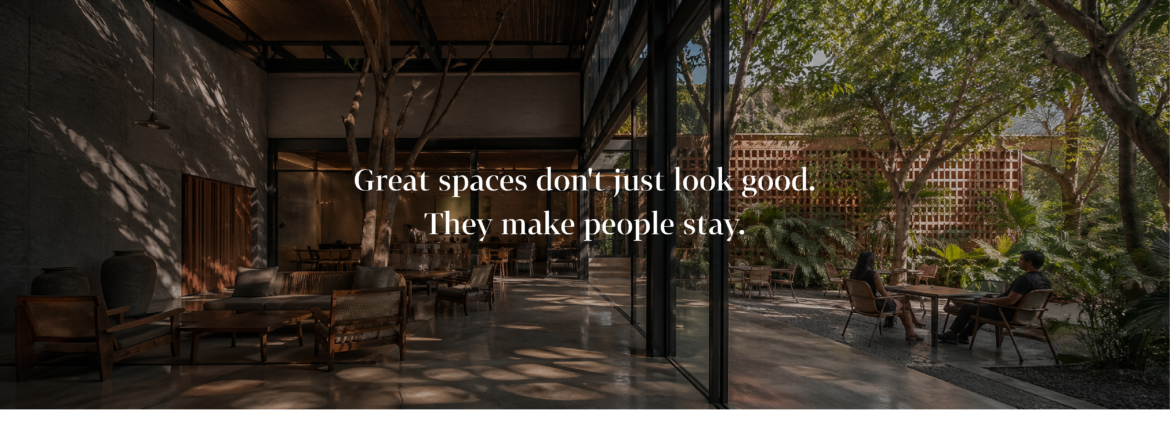
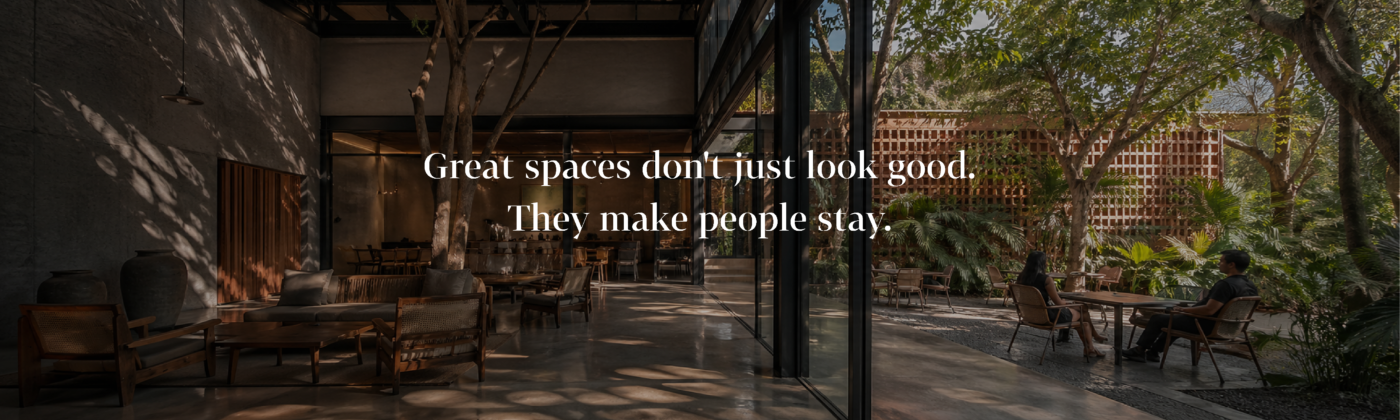
The most common hospitality brief we receive is essentially: “Make it look good.” The most useful hospitality brief we’ve ever received was four words from a client planning a café: “Make people want to stay.” That distinction between aesthetics as an end and behaviour as the objective changes every decision downstream. It changes zoning, lighting, sound treatment, the choice between an open kitchen and a closed one.
“The most useful brief we’ve ever received was four words: “Make people want to stay.””
If you are planning a hospitality space and you cannot answer the following before your first meeting with a designer, you don’t yet have a brief. You have a wishlist.
What is the dwell time you want, and what behaviours will produce it? Twenty minutes for a flat white is a different building from two hours for a long lunch.
What does this space need to do at 9am, 1pm, and 9pm? The most profitable hospitality interiors of the next five years will be adaptable ones.
What feeling should a guest describe to a friend the next day? If you cannot answer this in one sentence, the design cannot answer it either.
Lesson 2: Dwell Time Is a Design Metric, Not a Hospitality One
The hospitality industry talks about dwell time as an operations problem. How do you turn tables without making guests feel rushed? But dwell time is primarily a design problem. The length of time someone stays in a space is determined largely before they arrive, in the decisions made on a floor plan.
Zoning is the most important of those decisions. Most hospitality interiors are designed for maximum covers as many seats as the footprint allows. The interiors that perform best commercially are designed for maximum experience: distinct zones that serve different guest states, each with its own atmosphere and its own implicit invitation.
A private corner for a meeting. A counter seat for the solo guest who wants to feel part of the room without committing to it. An outdoor area that extends naturally from the interior rather than feeling like an afterthought. A lounge area that says “you can stay as long as you like.” Each is a design decision. Each of them affects revenue.
“Most interiors are designed for maximum covers. The ones that perform best are designed for maximum experience.”
This is one of the clearest lessons from the hospitality spaces we’ve designed across Sri Lanka. The operators who think about zones as “types of guest moments” rather than “seating configurations” end up with spaces that work at 30% capacity and at 100%. They also end up with spaces that guests find reasons to return to, because the room has enough different registers to serve them in different moods.
Lesson 3: Your Space Is Already on Social Media Design for It
If your venue has been open for more than a week, it is already being photographed and shared. The question is not whether your space appears on social media. It is whether it appears the way you intended.
The reflex response to this insight is to commission an “Instagram corner” , a feature wall, a neon sign, a styled vignette that exists purely to be photographed. This is the wrong answer, for a simple reason: it separates aesthetics from function, and guests can feel the seam. A space that is interesting to photograph because it is genuinely interesting to be in will always outperform a space with a designated photo opportunity.
The design decisions that produce shareable spaces are the same ones that produce good spaces: strong natural light, considered materiality, an identifiable visual language, a colour story that reads consistently across the room. These are also the decisions that make guests feel they are somewhere, rather than just somewhere to eat.
“A space that is interesting to photograph because it is genuinely interesting to be in will always outperform a space with a designated photo opportunity.”
The practical implication: when briefing a designer, share the Instagram accounts of the venues your target guests already frequent. Not to copy them, but to understand the visual language your future customers already speak. The best hospitality design in Sri Lanka right now is not designing for Instagram. It is designing spaces worth being in and the photographs follow.
Lesson 4: Sri Lanka’s Climate Is a Design Opportunity, Not a Constraint
The global hospitality design conversation is currently obsessed with biophilic design: the integration of natural elements, greenery, and organic materials into commercial interiors. What is new to the international market is, for Sri Lanka, simply how our grandparents built verandas.
Open courtyards. Permeable thresholds. Deep eaves, cross-ventilation, and the play of light through screens. Materials that age into beauty rather than degrading terracotta, lime plaster, polished cement, jak wood. Sri Lanka has a regional design vocabulary, developed most explicitly by Geoffrey Bawa and the tropical modernist generation that followed him, which the rest of the world is now trying to learn.
The opportunity for Sri Lankan hospitality operators is to treat this not as a stylistic gesture, but as a structural approach. A courtyard is not a decoration. It is a ventilation strategy, visual anchor, event space and natural light source. A shade tree integrated into a ground-floor café is not a prop. It creates enclosure, shapes the path of guest movement, and produces a sensory experience no ceiling installation can replicate.
“What the world calls biophilic design, Sri Lanka has always simply called architecture.”
The operators doing this well are not looking to global references for their design language. They are drawing on what is already here: the climate, the materials, the light and treating them as assets rather than challenges to be air-conditioned away. The result is interiors that feel genuinely rooted in their location, which is precisely what the experience-economy traveller is looking for.
Inside the Hidden Brief: What The Blac Got Right
The clearest test of everything in this post is a project we designed for ourselves. Cafe BLAC now in its second outlet on Bagatalle Road, Colombo was conceived to mark ten years of ARA. That gave us the rare freedom to design without a client’s brief, which meant we had to write one that was entirely honest about what we were trying to achieve.
The brief we settled on was not “a café.” It was a third place: a space between home and office where dining, work, long conversations, and content creation could coexist without any one of them dominating. That single reframe changed everything downstream.
The plan responded by zoning the space into distinct atmospheric registers: a Glasshouse that shifts from a sunlit breakfast setting to an intimate evening room; a Garden that holds long brunches and laptop hours; an interior café for more conventional dining; and, upstairs, a private lounge, a boardroom, and a dedicated content space in quiet acknowledgement of the fact that a 2025 café also needs to host meetings, workshops, and shoots.
The design language stayed quiet throughout. Muted tones, natural light, threaded greenery but no forced “Instagrammable” moments, no staged jungle. The brief we kept returning to was a single sentence written in our first planning meeting: “How do we make a place feel calm without making it feel empty?” That is the kind of brief most clients never give their designer. It is also the kind of brief that produces buildings worth returning to.
What This Means for Your Space
The hospitality spaces that will define the next decade of Sri Lankan dining and accommodation are not necessarily the most expensive ones. They are the ones where a clear brief, a genuine answer to the question of what the space is for and who it is for drove every design decision from the beginning.
That means thinking about behaviour before furniture. About feeling before it ends. About the three most common things your guest will do in your space, and whether your current floor plan supports any of them and it could.
It means treating the climate, the materials, and the design inheritance that are uniquely Sri Lankan not as compromises to be managed, but as a starting point that the world’s most interesting hospitality projects are trying to reach from the outside.
And it means writing a brief that goes deeper than the moodboard one that captures the experience you are trying to build, not just the room.
Planning or Redesigning a Hospitality Space?
If you’re thinking about a new venue, a refurbishment, or a second look at a space that no longer earns its rent, we’d like to hear the brief you came in with and help you find the one underneath. Visit ara.lk to explore our portfolio, or contact us directly to start the conversation about your project.